
By Tomer M. Israel, Adv. | [Date]
Disclosure: The author has represented Roy Miller in Israeli proceedings. This article draws on public court filings, is not legal advice, and discloses no client confidences. Allegations are attributed to the parties. Nothing described as an allegation has been found true by a court unless a court order says so. The account is current through Miller’s motion of August 13, 2026.
Five of the seven defendants in Miller v. Tsabary, No. 2025-017361-CA-01, a civil action before Judge William Thomas in the Eleventh Judicial Circuit in Miami-Dade County, are now in default. According to Miller’s filings, the defaulted defendants were served under the Hague Service Convention, the treaty channel that governs service between the United States and Israel. Two never appeared. Three contested Florida’s jurisdiction through counsel until that counsel told the court their clients would not participate. The remaining two defendants, both Florida lawyers, have not defaulted, and how they have litigated is now part of the story.
The Campaign Miller Describes
Roy Milleris a journalist who has lived in Miami-Dade County since 2014. His verified amended complaint, filed August 18, 2025, portrays Guy Tsabary, an Israeli attorney, as the organizer of a campaign to break him financially and silence his reporting. It alleges that beginning in 2017 Tsabary recruited clients to file defamation suits against Miller in Israel and obtained default judgments by serving him by email and mail rather than through the Hague channel, sometimes at Florida addresses where Miller did not live, and in one case at a Florida nursing home on a return receipt signed by someone else. Miller says several of those judgments were later vacated by Israeli courts.
The complaint further alleges that Tsabary used the judgments to start an Israeli bankruptcy proceeding aimed at Miller’s assets, which an Israeli court dismissed in 2019 and the Israeli Supreme Court left dismissed on appeal; that he and one client obtained an arrest warrant in 2019, the judgment behind which was vacated in November 2024; and that in October 2024 he commissioned, for a client, a handwriting expert’s report calling a consular-verified medical letter of Miller’s a forgery. Miller says the report was used to block his remote testimony in Israel and was later leaked to a website. In Florida, the complaint alleges, Tsabary filed motions to quash Miller’s subpoenas to GoDaddy under the alias “Ben Oren,” and registered that identity on the state e-filing portal with his work email while paying related fees through his own PayPal account. It also alleges that a video appearance on September 6, 2023 was AI-generated. The judge’s written order the next day says only that the person appearing could not produce identification.
The Israeli Clients
Four of Tsabary’s Israeli clients are also defendants. Their names are on the public docket, Hod Tsadkani, Eytan Levy, Guy Michael Willis, and Maor Parente, several of the Israeli decisions carry publication bans. Miller alleges that at least two of them obtained Israeli default judgments that courts later vacated, that all four knew he lived in Florida when they sued, and that their service attempts and enforcement efforts were aimed at him there. He alleges that one of the four, Eytan Levy, commissioned and paid for the handwriting report, was told in January 2025 that it was false, and did not correct it, and pursued enforcement of a 300,000-shekel judgment in a separate Miami-Dade case. The counts against these defendants are malicious prosecution, abuse of process in a foreign forum, emotional distress, and, for some, defamation and conspiracy.
The Florida Lawyers
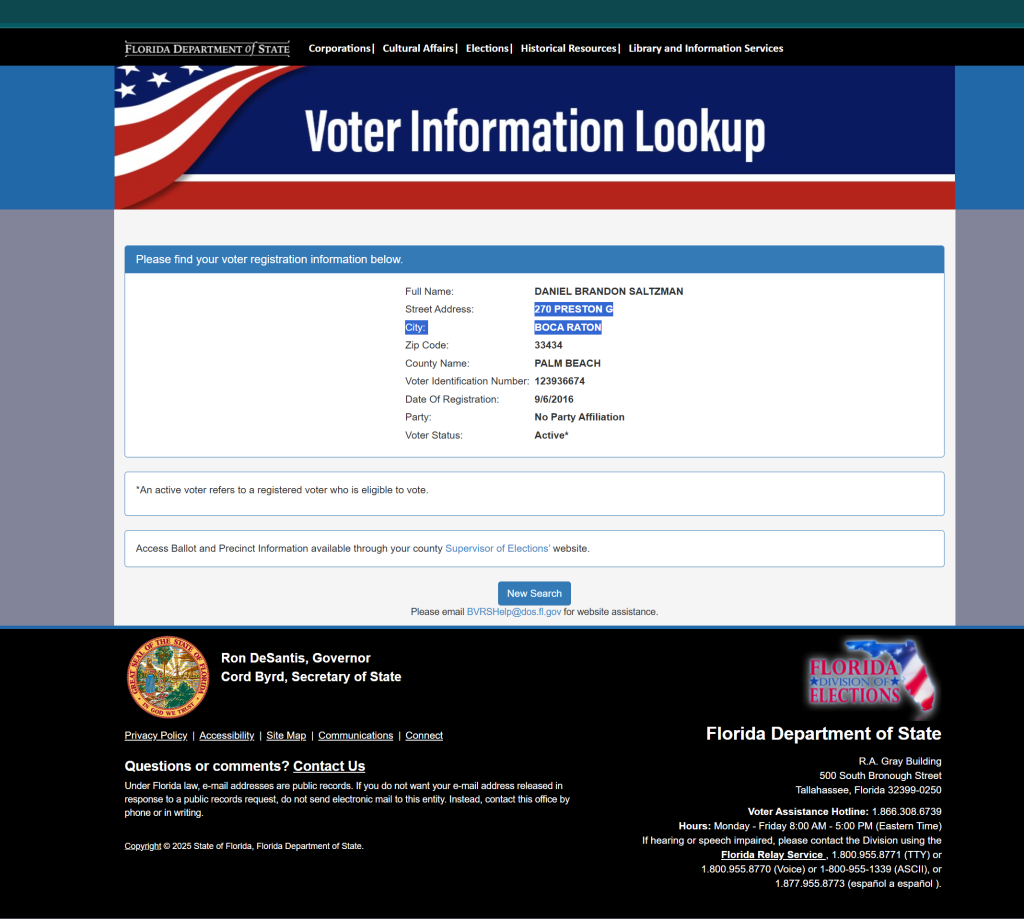
Shlomo Nizahon and Daniel Saltzman, who practice together as Nizahon P.A., are accused of helping in Miami-Dade. Miller alleges that on August 31, 2023 the two appeared at a Zoom hearing in a Coral Gables small-claims case in which they had no standing, using a link he says Tsabary passed to them under his alias, and that they later joined Tsabary’s request to subpoena Miller’s then 78-year-old mother. He says that as lawyers they owed the court candor and owed third parties respect, and that by appearing they lent credibility to Tsabary’s use of an alias. On those allegations, he pleads abuse of process, civil conspiracy, and two counts of emotional distress against them, and asks for referral to the Florida and Israeli bars.
What the Florida Court Records Show
The court records both support and limit those allegations. On September 7, 2023, Judge Patricia Marino Pedraza denied a non-party’s motion to quash the GoDaddy subpoena, noting that the person appearing as “Ben Oren” could not produce identification. On March 20, 2024, Judge Jorge Perez Santiago, ruling in a second small-claims case on Miller’s unopposed motion and affidavit, wrote that Tsabary “may, in fact, be” the “Ben Oren” who had filed the motion to quash, citing GoDaddy account records that appeared to show the account moved into Tsabary’s control. He referred the matter to the Israel Bar. The court’s service list for that order shows both “Ben Oren” and “guy tsabary” at the same email address.
As to the lawyers, Judge Santiago’s order says that two attorneys for a man identified as Tsabary appeared at a Zoom hearing when Ben Oren did not, that he would not let them argue without notices of appearance and a motion to intervene, and that they never explained how they learned of the hearing and never filed either. The order does not name them, and it does not say that anyone gave them a link. A handwritten court memo of that hearing lists the appearances of Saltzman and Nizahon and appears to record that the court wanted a notice or written explanation of their interest. In 2024, Saltzman, as counsel for Tsabary as a non-party, twice asked Judge Pedraza for authority to subpoena witnesses, including Miller’s mother, in connection with Tsabary’s effort to vacate Miller’s small-claims judgment. She denied the request on May 15, 2024, finding no relevant authority had been presented.
The Defendants’ Answers
Tsabary’s answer, filed through Nizahon P.A. on December 17, 2025, is that Florida cannot reach him. He says he lives and works in Israel, has no Florida contacts, and that everything alleged occurred in Israel in Israeli proceedings, with the “Ben Oren” identification an inference rather than a fact. He argues that Israel is the better forum and that Miller is trying to relitigate Israeli judgments. His counsel also filed a notice of limited appearance accusing Miller of filing a forged Answer in Tsabary’s name and asking for a criminal-contempt show-cause order. No ruling on that accusation appears in the papers reviewed for this article. Tsabary never attempted to prove these allegations.
Nizahon and Saltzman answer differently. In identical motions filed January 12, 2026, they argue that every act alleged against them was part of judicial proceedings and is therefore protected by Florida’s absolute litigation privilege, that Miller should have sought contempt or Bar discipline in the original cases, and that his claims are barred as compulsory counterclaims. On February 12, each filed a motion for sanctions under section 57.105, Florida Statutes, seeking fees for what they call frivolous claims. Miller responds that the privilege does not reach fraud on the court, and that he was the plaintiff in the small-claims cases while the lawyers were non-parties, so the counterclaim rule does not fit.
Served, Then Silent
The defaults followed service through the Hague Service Convention, according to Miller’s filings. Israel is a party to the treaty, and service runs through its Central Authority, which certifies delivery. Two defendants served on November 9, 2025 did not appear at the January 15, 2026 default hearing, and on January 19 the court entered a default final judgment as to liability against them, finding they had been duly and properly served.
The other three defendants, Tsabary and two Israeli clients, had contested jurisdiction through Nizahon P.A. On June 24, 2026, the firm asked to withdraw as their counsel, telling the court that the clients had said they refused to submit to its jurisdiction and would not participate in the litigation (after the Motions to dismiss were DENIED) and that it had warned them of the consequences. Saltzman, the firm’s other attorney, had already filed a notice of withdrawal. On July 21, the court granted Miller’s motion and entered judicial default against all three. The order gives no reasons.
Service through the treaty matters because of Article 15, which bars a default judgment against a defendant served abroad unless service followed a method the Convention allows, or the papers were actually delivered in time to defend. A defendant served through the Central Authority cannot easily claim the case reached him by surprise, and the defense lawyers’ own June statement describes clients who knew of the case and chose not to take part.
The Florida Lawyers’ Conduct
Miller’s account of the Florida lawyers turns on a pattern he says began in 2023 and continued into this case. At the small-claims hearing, he says, they appeared for a client whom the court thought might be the person behind a pseudonymous filing, and never explained how they learned of the hearing or what interest they had. In this case, Tsabary’s counsel asked the court on November 26, 2025, to take judicial notice of an Israeli ruling, moved to dismiss for lack of personal jurisdiction on December 17, filed a “limited appearance” the next day, and noticed a deposition on December 22, all while reserving the jurisdictional objection. Whether such a reservation survives that participation is a legal question that the papers reviewed do not show the court has addressed.
Miller also points to the lawyers’ own motions to dismiss, which are word-for-word identical and open by invoking the long-arm statute and forum non conveniens, doctrines designed for foreign defendants, though both movants are Florida residents. The arguments actually made concern only the litigation privilege and a counterclaim rule. His August 13 motion states that neither lawyer attended the May 13, 2026 hearing on their amended motions, which he says had never been set for hearing within the court’s 30-day window. The court denied the motions that day, reheard them on June 4, and on August 7 granted them in part on a proposed order that Miller says was submitted out of sequence while his own was deleted from the court’s CourtMAP system. The motion asks the court to clarify or vacate that order. The defendants oppose it.
Then there is the sequence of the summer of 2026. The firm that had argued Tsabary’s jurisdictional objection told the court on June 24 that Tsabary and two Israeli clients would neither submit nor participate, and asked to be relieved. Within four weeks the three were in default.
None of this has been found by a court to be improper. The lawyers say the acts alleged against them were ordinary advocacy inside judicial proceedings, and Judge Santiago’s order makes no finding about either of them beyond what they did not file. The professional rules on conflicts and on lawyers as witnesses, which are ordinarily implicated when lawyers are at once defendants and counsel to co-defendants, have not been the subject of any ruling in the papers reviewed. What the record shows is a series of choices by counsel that Miller characterizes as evasive and that they characterize as advocacy, and that the court has yet to sort out.
What a Default Does Not Settle
A default admits the well-pleaded facts of liability, not the amount of damages, and Miller will have to prove those at a hearing. He alleges expenses defending Israeli-judgment enforcement efforts in Miami-Dade, and he has reserved a claim for punitive damages that Florida law bars pleading without leave of court.
The Israeli Record
The Israeli decisions Tsabary put before the Florida court complicate the picture. On June 3, 2025, a Tel Aviv–Jaffa Magistrate’s Court judge denied Miller’s motions to set aside default judgments in all but one of eight cases, granting the other on condition of a 200,000-shekel deposit. He found the claims had been served under court-approved alternative service, chiefly emails to active addresses and social-media accounts, and that Miller knew of the suits, and he described procedural bad faith. The same decision recognizes that other Israeli courts vacated default judgments in three cases. Miller’s complaint, filed two months later, does not address the service finding, though he can point out that the ruling was open to appeal and that Israeli judges have not been uniform.
The handwriting report at the center of the forgery dispute, prepared in October 2024 for one of the Israeli clients through Tsabary’s office, calls a consular-verified medical letter a probable forgery on the basis of a photocopy. The same Tel Aviv decision found the medical documents “not proven authentic.” The report’s author is sued separately in Miami-Dade, represented by the same law firm, and has sworn that she sent it to no one in Florida other than her lawyers. The irony is not lost on either side: Miller has spent years attacking Israeli defaults as products of defective service, and his Florida defaults against Israeli residents will draw the same scrutiny.
What Comes Next
BENCH TRIAL TO DETERMINE DAMAGES.
Sources: court filings and exhibits in No. 2025-017361-CA-01 and related Miami-Dade and Israeli matters, through Miller’s motion of August 13, 2026. Legal authorities have not been independently verified; consult counsel before relying on them.